
AI Agents Are Replacing SaaS — Here's What That Means for You
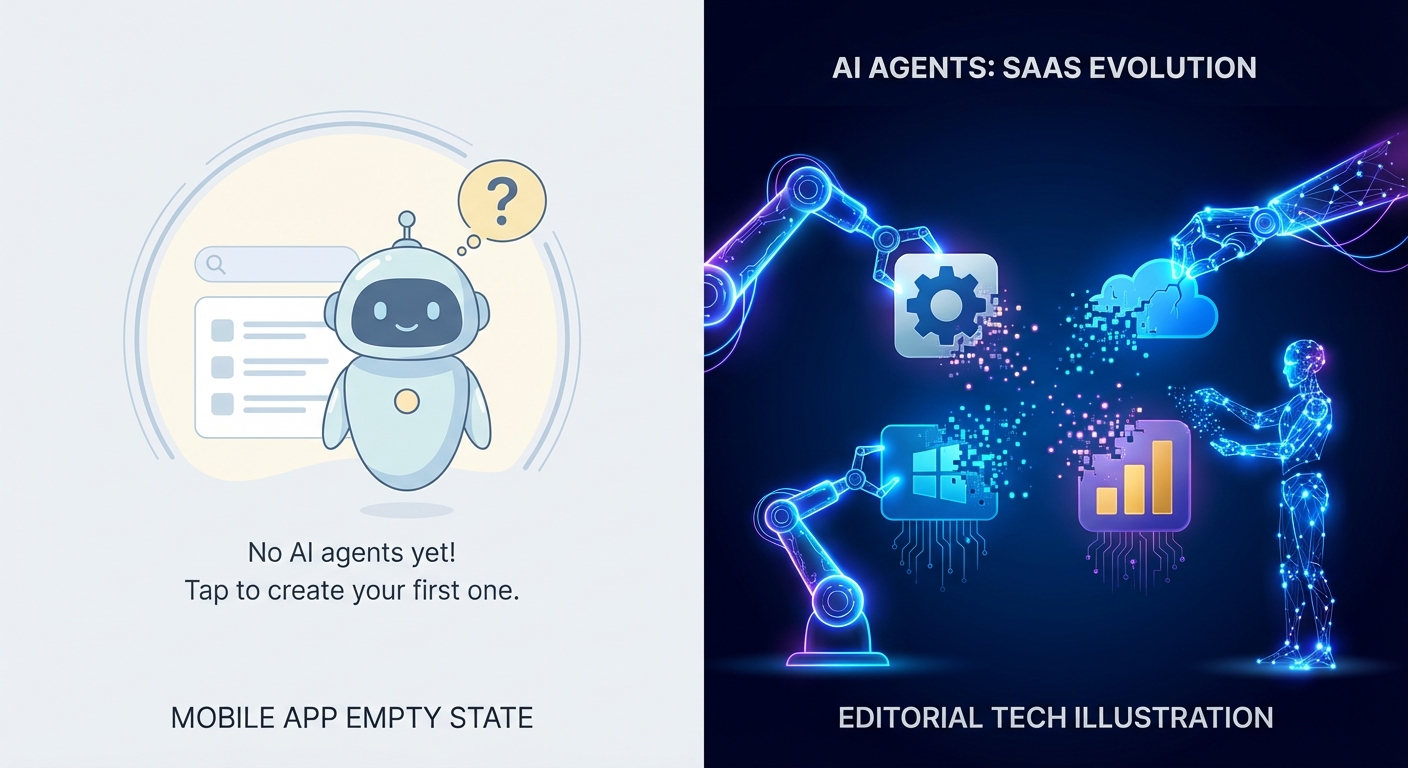
For the last decade, software meant SaaS. You'd subscribe to a tool, learn its interface, and manually move data between a dozen disconnected products. That model is starting to break.
AI agents don't integrate with your workflow. They *are* your workflow.
What an AI Agent Actually Does
A traditional SaaS tool waits for input. You open it, you click, it does one thing. An AI agent monitors context, makes decisions, takes actions across multiple systems, and loops until the job is done — without you logging in.
Here's a concrete example: instead of subscribing to a CRM, a support tool, and an email sequencer separately, an agent watches your inbox, qualifies leads, logs them in your database, drafts personalized follow-ups, and schedules calls — all triggered by a single incoming email. No dashboard. No manual handoffs.
This isn't hypothetical. Tools like Relay.app, Make, and newer entrants like AgentGPT are running multi-step automations that would have required a part-time ops hire two years ago.
Why SaaS Companies Are Nervous
The SaaS business model depends on stickiness: the more you use the interface, the more locked in you get. But if an agent handles the interface layer for you, the underlying SaaS tool becomes a commodity. What matters is the data and the API — the pretty dashboard is irrelevant.
This is why you're seeing established SaaS companies scramble to release their own AI features. Notion, HubSpot, Salesforce, Monday — they're all adding copilots, agents, and automation layers. Not because AI makes their existing product better, but because if they don't own the agent layer, someone else will sit between them and their customers.
The risk for SaaS businesses isn't that AI replaces their product. It's that AI commoditizes it.
The Categories Getting Hit First
Customer support is the clearest example. AI agents using tools like Intercom's Fin or Sierra are resolving 60-80% of support tickets without human involvement. The support SaaS market doesn't disappear — it compresses. Fewer seats, lower ACVs, more competition.
Sales outreach is close behind. AI SDRs built on tools like 11x or Artisan are running entire outbound sequences: research, personalized email, LinkedIn touchpoints, follow-ups. The human still closes, but everything before a call can now be automated.
Data analysis and reporting is eroding too. If you're still paying for a BI tool that requires someone to build dashboards, you should be asking whether a data analysis agent can just answer the question in plain English. For a lot of companies, the answer is already yes.
Check the full AI agents category on TryAnAI — there are 400+ tools in there, and the category is growing faster than any other.
What This Doesn't Mean
SaaS isn't dead. That's too clean.
What's actually happening is a bifurcation. Tools that provide genuine data moats — your payment processor, your git repository, your accounting software — will survive because the data itself is valuable, not the UI. Tools that are purely workflow orchestrators with no unique data are the ones in trouble.
Also: agents are still pretty bad at complex judgment calls. They hallucinate, they hit edge cases, they get stuck in loops. For anything where the downside of a mistake is significant — legal, medical, financial — humans aren't going anywhere. Agents are taking the repetitive, high-volume, low-stakes work first.
What You Should Do Right Now
Audit your SaaS stack. For every tool you're paying for, ask: does this require my judgment, or am I mostly clicking through a workflow? If it's the latter, an agent can probably do it.
Start with one agent experiment. Don't try to automate everything at once. Pick one repetitive process — lead qualification, content scheduling, expense categorization — and run a proper test with an agent tool. Measure the output.
Build on APIs, not dashboards. When evaluating new software, weight API quality heavily. The tools that will matter in five years are the ones that agents can access programmatically, not the ones with the prettiest interface.
The shift from SaaS-first to agent-first isn't a future prediction anymore. It's already in your quarterly invoice if you know where to look.
Where to Start
- Browse AI agent tools — 400+ options, filtered by use case
- Compare agent builders: Make vs Zapier and see which handles complex logic better
- Check AI automation tools for workflow-specific options
- See Relay.app's full profile — one of the better newcomers in this space