
AI Tools for Tree Service Companies 2026
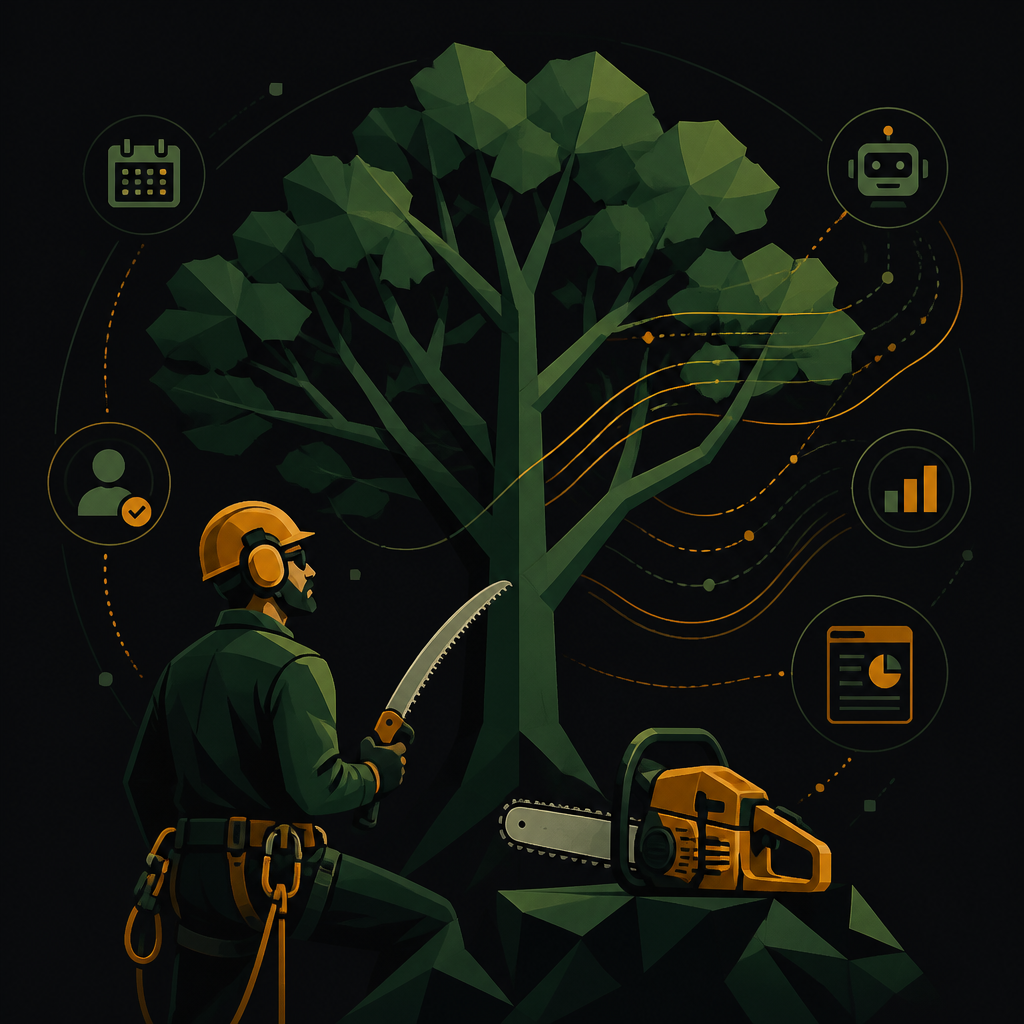
Tree work is two jobs sharing one truck. The first is the actual work — standing under a leaning silver maple and reading it, knowing that a co-dominant trunk with included bark is a failure waiting for the next storm and not a $400 trim, spotting the dead top that means a removal instead of a crown reduction, clocking whether the oak that dropped a limb has root rot or just took a bad wind, judging the fifteen feet of clearance you don't have between the drop zone and the neighbor's roof, knowing the difference between a tree you climb and a tree you crane. The second job is everything around the work — the estimate, the callback, the storm-week phone that won't stop, the customer who got one big removal and never heard from you again. AI is genuinely great at the second job. Keep it completely off the first.
The money in tree service doesn't leak on the rope. It leaks at the estimate that took four days to send, the storm lead that called three companies and booked whoever answered, and the property owner who paid $3,000 once and forgot you exist.
The bright line first
Before any tool: AI never assesses the tree in person. It does not price a removal, a crown reduction, or a stump job sight unseen. It does not decide whether a tree is a hazard, whether it's diseased or just stressed, or whether the job is a climb, a bucket, or a crane. It does not judge proximity to power lines, structures, or a septic field. It will happily look at a photo and say "looks healthy, light thinning" when there's a girdling root and a cracked union that make it a removal — and that's how you underbid a two-day crane job by half, or miss a hazard and own the liability when it comes down on a garage. The walk-around, the risk assessment, the disease and pest ID, the removal-versus-save call, and anything near power lines are your certification and your eyes, full stop. Use AI to write the estimate and answer the phone — never to size up the tree.
Estimates without the four-day delay
Tree estimates are fiddly because the price hides in the access — tree size and species, dead or alive, distance to the drop zone, whether the crane fits down the driveway, haul-away versus chip-on-site, stump grinding, the permit some towns want for a big removal. Describe the job in plain language: "large dead ash, 60 feet, ten feet from the house, no crane access so it's a climb-and-rig, full haul-away, plus grind the stump, permit required." Hand that to ChatGPT and it turns your shorthand into a clean written estimate — the removal scope, the access note, the stump line, what changes if the tree's worse than it looked from the road — so there's no "you never said it'd be that much" argument in the yard. For a company running a dozen bids a week, Claude holds a long back-and-forth without losing the property, the scope, or the access constraints. You set the prices; the writing drops from twenty minutes to three. If you only want one assistant, ChatGPT vs Claude breaks down which fits.
Lead capture — where tree companies bleed money in storm season
The phone rings while you're eighty feet up with a running saw, and that emergency limb-on-the-roof lead books the outfit that picked up. You cannot rig a top and work the phone. An AI-assisted CRM like HubSpot's free tier catches the inbound and holds the "who called that I never quoted" list no crew leader tracks reliably from a bucket. Pair it with fast inbox triage — Superhuman clears a backlog of estimate replies between jobs — and the lead stops slipping. Tree demand is brutally spiky: a single windstorm generates a month of removals in one afternoon, and the company that answers on the first ring wins the whole street. Miss the call during the spike and you miss the year's best money.
Follow-up and re-work — the quiet retention game
Most tree companies treat every job as one-and-done, and that's the mistake. A property with mature trees needs work again — the reduction you did this year wants a follow-up prune in two or three, the neighbor watched you take down the dead ash and wants a quote, the customer who paid for a removal has three more trees you flagged as "watch these." Make.com connects your estimate form, your CRM, and your messaging so a finished job fires a review request while the chips are still on the lawn, a seasonal reminder before the next storm season, and a win-back nudge to anyone you cleared once and never followed up. Start with one thing — a review request the day after every job, with a referral ask attached — automate it, then add the next. Tree work spreads by word-of-mouth down a street; a review-and-referral flow is the difference between chasing storm leads forever and a book of repeat property owners.
Lookups and customer comms
A tactful way to explain why a crane removal costs what it costs, an aftercare note on watering a newly-planted replacement, a firm-but-polite script for a customer who keeps pushing to "just top it" (which you won't do because topping kills the tree) — Perplexity AI drafts and researches them fast with sources you can click. Treat it as a writing assistant, never an arborist — keep it away from "is this tree safe to leave standing." If you live in Microsoft 365, Microsoft Copilot does the same drafting inside Outlook. And Grammarly keeps a two-truck company's estimates and texts reading as sharp as a franchise's.
Tree work is one of the most dramatic before-and-afters in any trade — a leaning hazard gone, a crane pick over a house, a mess of storm debris cleared clean — and most companies waste that free marketing. One person can run an agency-grade feed: Canva's Visual Suite turns a crane-removal photo set into scroll-stopping posts and door-hanger flyers, while Jasper and copy.ai crank out service-page copy and storm-season promos — see Jasper vs copy.ai if you only want to pay for one. Want a 30-second clip explaining why crown reduction beats topping? Synthesia builds one without a camera. The full AI marketing tools shelf is there if you're chasing more local work.
Don't lose the walkthrough
If you record your on-site assessments, Otter.ai and Fireflies.ai transcribe them so the details — "the back oak has a hanger over the shed, flag it," "gate's too narrow for the mini-loader, hand-haul," "customer wants the maple saved, not removed" — land in the property file instead of evaporating between the estimate and the crew showing up. Get consent first.
Where I'd start
If you do nothing else this season: put an AI assistant on your estimate writing, a CRM with real follow-up on your inbound calls, and Make.com on your review-and-referral request. Those three claw back the most hours and protect the most repeat revenue. Everything else is upside.
The tree companies winning in 2026 aren't the ones who "use AI" to bid a removal from a photo — they're the ones who let AI handle the estimates, the storm-week phone, and the follow-up so they can stay on the ropes, and who never let it judge a tree it can't see.
Try Them Yourself
- Build your front-office stack from the AI productivity tools collection
- Land more storm-season work with AI marketing tools
- Sharpen customer-facing copy with AI writing tools
- Compare the big assistants head-to-head: ChatGPT vs Claude
- Pick a copywriter: Jasper vs copy.ai