
Perplexity AI vs ChatGPT Search: Which One Actually Finds Better Answers?
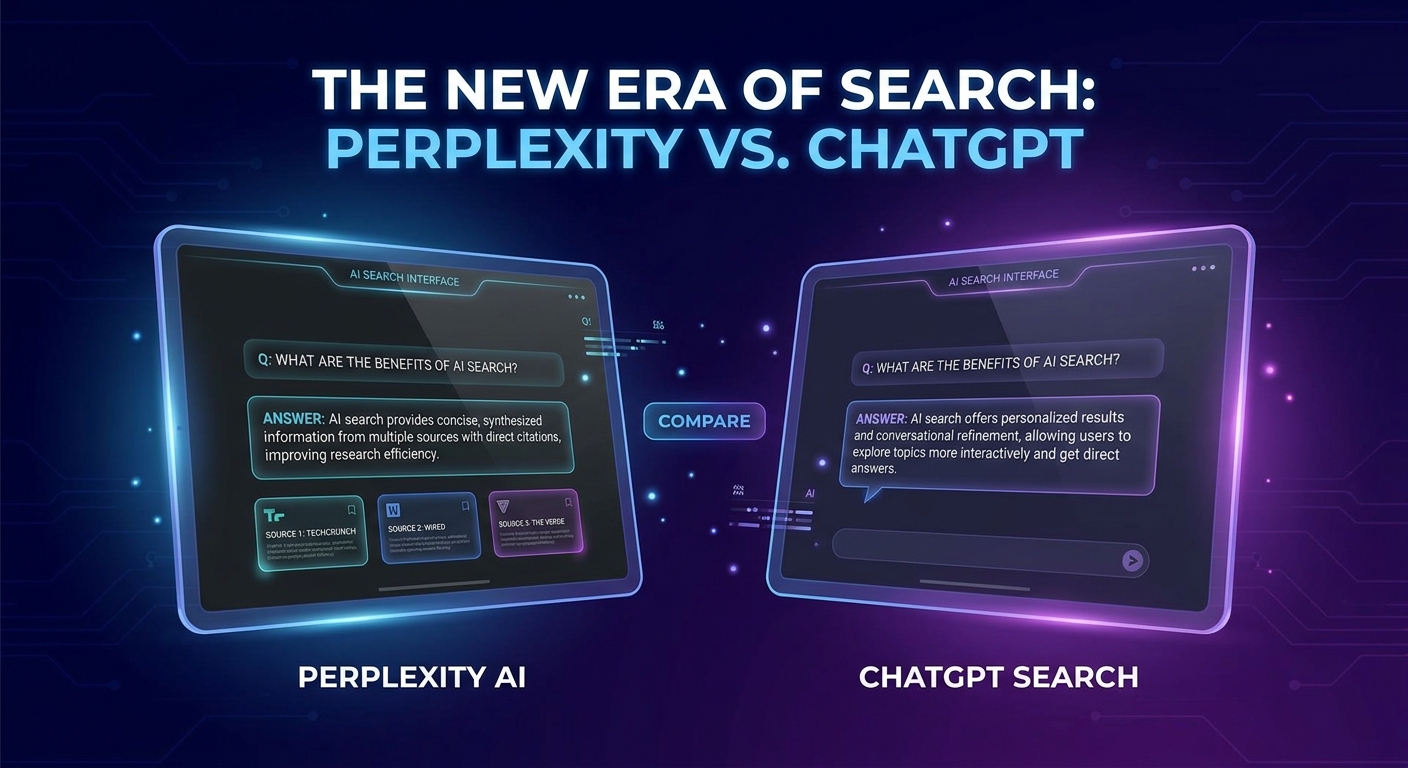
I've run the same 50 queries through both tools over the past few weeks. Not cherry-picked queries — the actual things I search for: recent news, technical docs, product comparisons, local recommendations, and the kind of niche factual questions that send you down a Wikipedia rabbit hole. Here's what I found.
The short version: Perplexity is better at most things people think of as "search." ChatGPT Search is better when you already know roughly what you're looking for and want to explore it conversationally. They're not really competing for the same use case.
What Perplexity AI Gets Right
Perplexity's core innovation is citations that actually work. Every answer is annotated with sources you can click through and verify. This sounds obvious, but it's the feature that makes the tool trustworthy — you're not guessing where information came from.
The search quality for factual, time-sensitive queries is genuinely impressive. Ask about something that happened in the last 48 hours and Perplexity pulls from current news sources, not its training data. Ask about a specific company's recent funding round and you get actual numbers with links to the press releases.
The follow-up query flow is also well-designed. When you ask a question, the sidebar generates related questions automatically — and they're usually the exact follow-ups you'd think to ask. That kind of intent-modeling is hard to do right, and Perplexity does it right.
Where it falls down: Perplexity can over-index on recency. For questions where you want considered analysis — not just the most recent thing written on the topic — the results sometimes surface hot takes over substantive sources. And the Pro tier ($20/month) is almost required if you're using it heavily; the free tier's query limits get hit fast.
Browse Perplexity AI and similar tools →
What ChatGPT Search Gets Right
ChatGPT Search (part of ChatGPT Plus, or free with limited access) takes a different approach: it augments the model's reasoning with web results rather than building a search-first interface. This means the answers feel more synthesized and less like a curated list of links.
For open-ended research questions — "help me understand the implications of X" or "what's the current state of Y" — ChatGPT Search is better because it integrates sources into a coherent argument rather than presenting them as parallel citations. It reads more like a briefing and less like a roundup.
The conversational depth is also a real advantage. When you follow up with "but what about Z," ChatGPT keeps context across the whole thread in a way that Perplexity doesn't quite match. For iterative research sessions, this matters.
Where it falls down: Accuracy on very recent events is shakier. ChatGPT's integration with Bing Search works, but the model sometimes conflates its training knowledge with search results — you can get subtly wrong answers presented with confidence. The citation UI is also less prominent than Perplexity's, which makes verification slower.
See ChatGPT and alternatives →
The $20/Month Question
Both tools cost $20/month for their best tiers (Perplexity Pro, ChatGPT Plus). That's an identical price for genuinely different products.
Perplexity Pro gives you unlimited searches, access to Claude 3.5 Sonnet and GPT-4o as underlying models, image search, and Spaces (their way of building focused research environments). The value is real if search is where you spend serious time.
ChatGPT Plus gives you GPT-4o, GPT-4o with canvas, image generation with DALL-E, and ChatGPT Search. The value proposition is breadth: you're getting a capable AI assistant that also has web access, not a specialized search tool.
If you're evaluating purely on search quality and citation reliability, Perplexity is the stronger tool for the same money. If you want a general AI assistant where web search is one of many capabilities, ChatGPT Plus covers more ground.
When To Use Each
Use Perplexity when:
- You need to verify facts fast and want citations without digging
- You're tracking a fast-moving story or recent events
- You want to build a structured research view on a topic (Spaces is legitimately useful)
- You're replacing a Google habit, not a ChatGPT habit
Use ChatGPT Search when:
- You want to think through a topic conversationally
- You need synthesis, not just a list of relevant sources
- You're already paying for ChatGPT Plus and search is a secondary use case
- The question is complex enough that follow-up depth matters more than citation density
The honest take: most people who are serious about research will end up using both — Perplexity for the initial quick pass, ChatGPT for the deep thinking. That's not a knock on either tool; it's just what good research workflows actually look like.
If you want something even more powerful for structured research, Elicit and Consensus are worth a look — they're purpose-built for academic and scientific queries where citation quality matters even more.
What Google Should Be Worried About
Both Perplexity and ChatGPT Search are doing something Google's AI Overviews still can't: producing consistently trustworthy answers that users actually want to read.
Google has the index advantage and the distribution advantage. But Perplexity and OpenAI both understand that the next generation of search isn't about returning ten links — it's about answering the question. Google is catching up, but it's behind.
For now, if you're spending $20/month somewhere, the question isn't Perplexity vs ChatGPT. It's which one fits how you actually work.