
The AI Tools Novelists Actually Use in 2026 (From Outline to Manuscript)
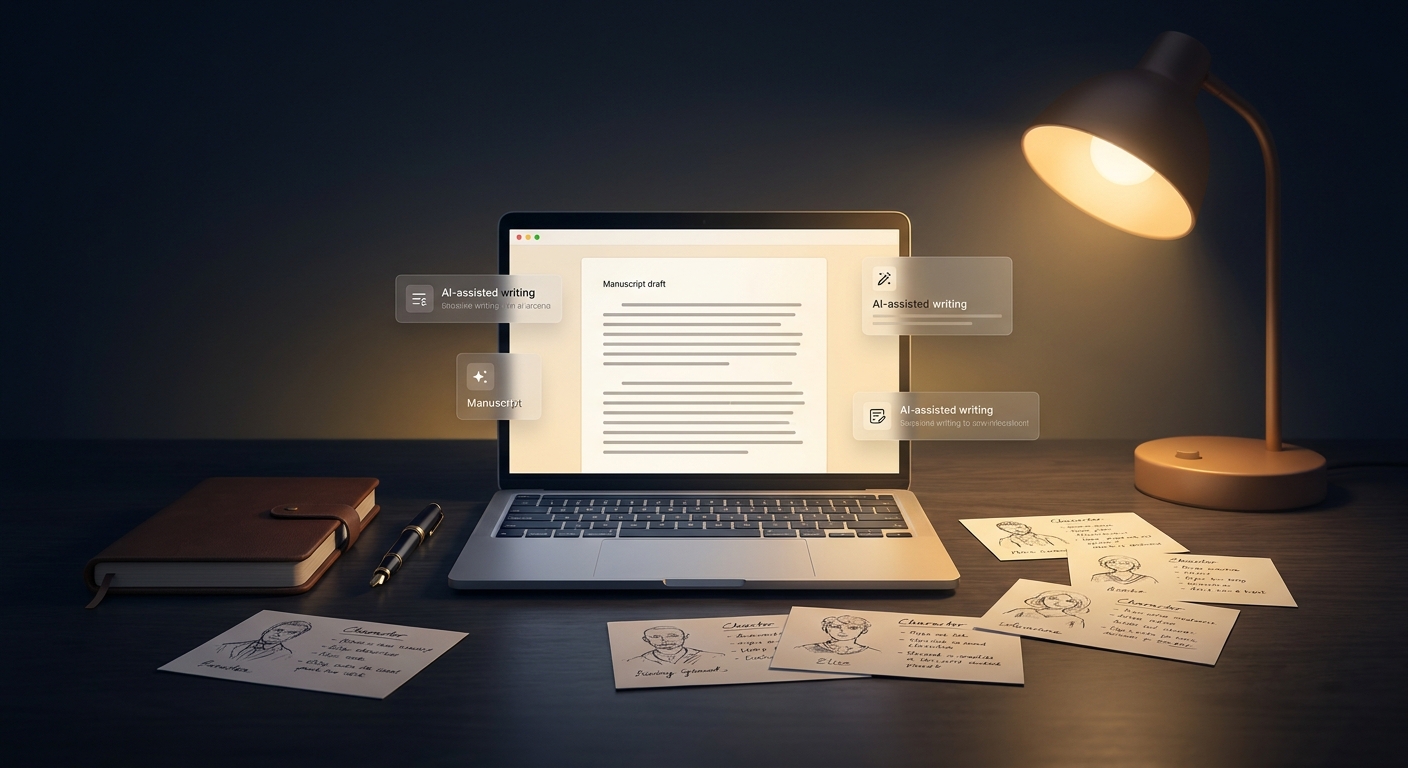
Sit in any working novelist's discord in 2026 and the fight is over. Not won, not lost — over. The writers who spent 2024 swearing they'd never touch "the slop machine" are now quietly shipping two books a year and answering reader email on the third. The writers who went all-in on full-AI generation are either selling at the bottom of Kindle Unlimited or have already pivoted to something else.
The interesting writers landed in the middle. The model drafts. The human owns the voice, the structure, and the call.
This is the actual stack I see on working novelists' monitors in 2026 — the people writing the books their readers preorder, not the people writing posts about writing books.
The five jobs of a novelist (and where AI earned a chair)
The job is plan, draft, revise, polish, ship. AI is genuinely good at three of those — planning, parts of drafting, and polishing. It is mediocre-to-bad at revision (the structural pass where you decide a subplot dies) and useless at ship (your name is on the cover, not the model's).
The writers winning are the ones who matched each phase to the right tool — and protected the phases the model can't help with.
1. Plan — the outline finally stopped being scary
This is where AI moved from "interesting" to "why would I work without it."
- Sudowrite — still the flagship for fiction. The Story Engine (outline → beats → scene cards) is the single best outlining workflow I've used. It won't write your book for you, but it will absorb your premise and hand back a workable three-act skeleton in twenty minutes. The writers I trust use it as a sparring partner, not a ghostwriter.
- NovelCrafter — the challenger that's eaten a real chunk of Sudowrite's market in the last year. Stronger codex (the wiki where your worldbuilding lives), better integration of your own notes into prompts, BYO API key if you want to run it on Claude. Picked by writers who like control over the model and the prompt.
- Plottr — not technically AI-first, but the timeline view is still the cleanest way to see your subplots collide. Use it alongside Sudowrite for structure work the chat interface can't show you.
- Notion AI — for the wiki side of worldbuilding. Character bibles, magic systems, location notes, all queryable. The writers running long series live in it.
The trap to avoid: do not let the model write your outline *for* you on a blank page. Bring it your premise and your three favorite scenes, and let it scaffold around your taste. Outlines a model invents in a vacuum are competent and forgettable.
2. Draft — the part that broke most writers' brains
This is the contested ground. Here's what I see actually working.
- Claude — the long-context model is what changed drafting. You can paste your full outline, your last three chapters, and your character bible into one prompt and ask for a scene draft that *actually remembers* the dog died in chapter four. Writers I trust use it for the "first ugly pass" of a scene and then rewrite by hand on top of it. The rewrite is where the voice lives.
- Sudowrite Write/Describe/Brainstorm — the in-line tools (continue this paragraph, expand this beat, describe this room) are the ones that actually get used during a session. Less "write my novel," more "unblock me on the next 200 words at 11pm."
- NovelAI — different audience. Genre fiction, fanfic, longform serialized work. Strong on staying in voice over very long contexts. The literary-fiction crowd doesn't use it; the prolific KU romance crowd absolutely does.
- ChatGPT — the brainstorm partner. Better for "give me five ways this scene could end" than for "write this scene." Used as the friend you DM at midnight, not the co-author.
For a deeper look at which of the big general-purpose models actually thinks the way a writer needs, see ChatGPT vs Claude.
3. Revise — the part you still have to do yourself
This is where most AI-heavy novels fall apart in editorial. The model can polish a sentence. It cannot decide that your B-plot is killing your pacing and the antagonist needs to be cut by 40%.
- Fictionary — story-structure analysis on a finished draft. It maps your scenes against story science and flags the ones doing no work. Used by writers prepping for an agent or an editor.
- AutoCrit — line-level analysis in a manuscript view. Pacing, dialogue ratio, repeated phrasing, filtering words. Less hand-holding than ProWritingAid; more useful at the manuscript scale.
- ProWritingAid — the kitchen-sink editor. Twenty-plus reports. Most writers use three of them (overused words, sentence variation, dialogue tags) and ignore the rest.
A caution: do not accept every suggestion. The tools will flatten your voice if you let them. The right posture is "this flagged a real issue 60% of the time and a stylistic choice 40% of the time, and I get to decide which is which."
4. Polish — line edits without the line editor's bill
- Grammarly — table-stakes. The 2026 version finally stopped suggesting you flatten every voicey sentence into corporate-blog English. Use it for the obvious stuff and turn off the "clarity" suggestions if you care about prose rhythm.
- Hemingway Editor — the readability check. Useful as a sanity pass, especially on dialogue. Do not write to it; it will turn your prose into a press release.
- Claude for line editing — paste a chapter, ask for "a pass for repetition, filtering words, and any sentence that doesn't earn its place — flag, don't rewrite." The flag-don't-rewrite instruction is the unlock. Without it the model will overwrite you.
5. Ship — covers, audio, marketing
The production stack got dramatically cheaper.
- Atticus — manuscript formatting for ebook and paperback. The Vellum challenger that won on cross-platform and price. Most indie authors I know switched in the last 18 months.
- Midjourney and Ideogram — cover concepting. The honest truth: you still want a human cover designer for your final cover unless you are deep in a sub-genre where reader expectations are obvious. Use these to brief the designer, not replace them.
- ElevenLabs — audiobook narration that doesn't sound robotic anymore. The voice cloning is genuinely good. Still ethically contested — check your publisher contract before licensing your own voice. Many writers are using it for short stories and Substack-attached audio rather than full novels.
- Descript — for the podcasting side of the platform-building game. Edit a launch interview like a Google Doc.
- Perplexity — research with citations. The historical-fiction crowd lives in it. The model that finally made fact-checking your own draft less painful than writing it.
For the broader social and marketing side, the Best AI Tools for Content Creators covers the platform-building stack — newsletter, video, audience.
What AI still can't do (and why this is the good news)
- Decide what your book is *about*. Theme is taste. The model can pattern-match what other novels are about; it cannot tell you what *yours* should be.
- Cut its own work. AI generates. It does not have the discipline to delete. Every novelist's job in 2026 is to be the one who deletes.
- Hold a voice across 90,000 words. It can hold a voice across 2,000. The drift over a full manuscript is the thing your editor will notice and your reader will feel without being able to name it.
- Care. The reader who DMs you about how your book got them through a hard year is not writing to a model. They are writing to you. That asymmetry is the whole moat.
The novelists losing in 2026 aren't losing to AI. They're losing to other novelists who used AI to skip the parts of writing that were never the point — the blank-page paralysis, the sixth re-read for filtering words, the formatting fight at 2am the week of launch — and reinvested that time into the parts that were always the point.
Try Them Yourself
- ChatGPT vs Claude — pick your drafting partner
- 10 AI Writing Tools That Don't Sound Like a Robot — wider survey of the writing surface
- Best AI Tools for Content Creators — for the platform-building side
- AI Tools for Solopreneurs 2026 — for the indie-author-as-business side
- Writing category — the full writing toolkit
- Productivity category — for the rest of the desk
Start with: Sudowrite or NovelCrafter for outlining and in-line drafting, Claude for long-context first drafts and line edits, Fictionary for structural revision, ProWritingAid or AutoCrit for polish, Atticus for layout, Midjourney for cover briefing, ElevenLabs for audio. That's the kit. Six tools the model owns, two seats the human keeps — the call on what the book is about, and the name on the cover.