
The Video Editor's AI Stack in 2026 (Transcript Editing, Auto-Captions, Generative B-Roll, and What's Still Theater)
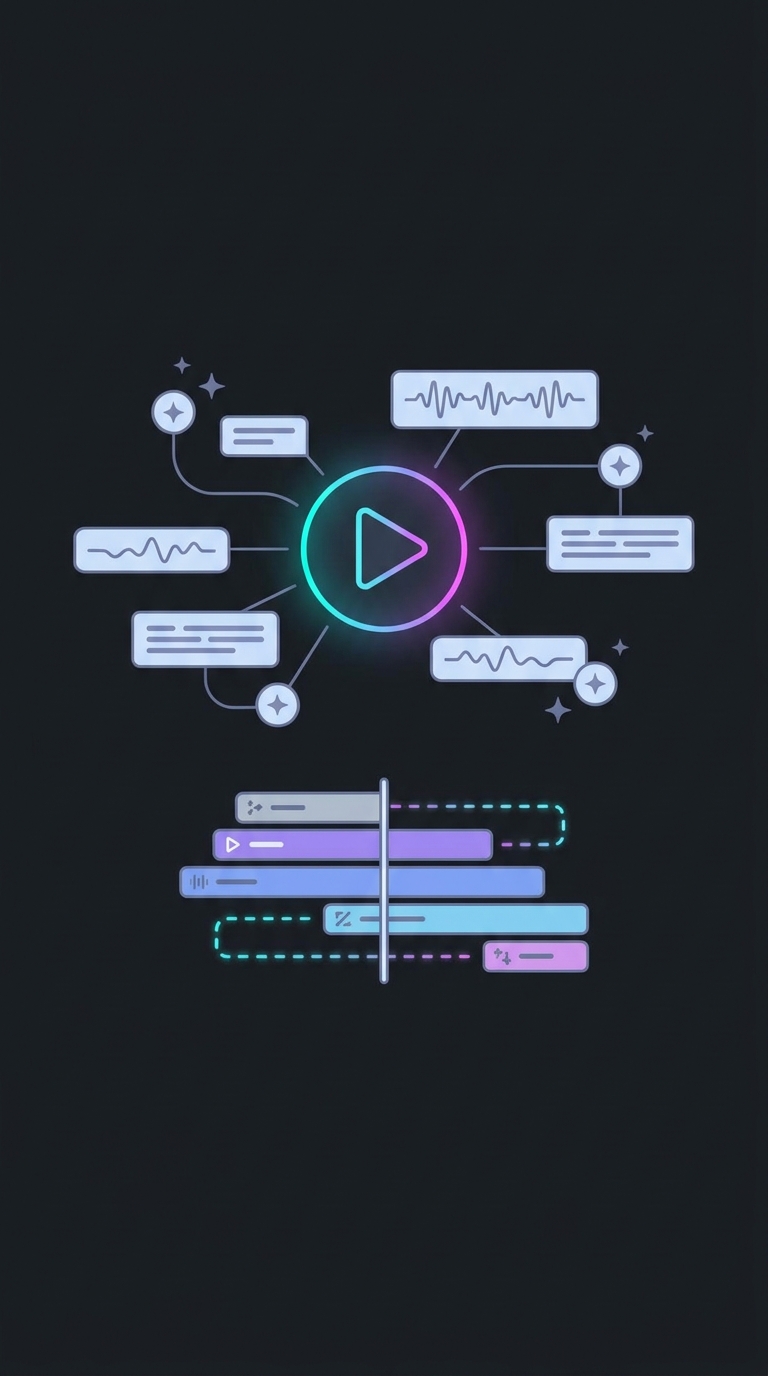
Timeline editing didn't die in 2026. But the editor who still scrubs frame-by-frame to cut a filler word, hand-keys captions, and licenses stock b-roll is doing three jobs a model now does in seconds — and getting out-billed by the editor who doesn't.
I spent the last month re-cutting real projects — a 40-minute podcast, a batch of founder talking-head shorts, and a product launch reel — using nothing but AI-assisted tools where I could, then timing the difference against my old Premiere muscle memory. The honest result: AI didn't replace the edit. It deleted the tedious 70% around the edit and handed the creative 30% back. Here's the five-layer stack that actually held up, and the parts that are still demo-ware.
The transcript-editing layer (where the hours actually vanish)
This is the layer that changes how editing *feels*, and the one tool every editor should try first.
Descript is the breakout, and it's not close. You edit the video by editing a transcript — delete a sentence, the footage goes with it. Its filler-word removal strips every "um" and "like" in one click, and Studio Sound makes a phone-mic recording sound like a treated booth. On the 40-minute podcast, a cut that used to eat an afternoon took 25 minutes. The catch: it's a word-first editor, so frame-perfect motion work still belongs in a real NLE. If you're weighing it against the browser-based crowd, Descript vs Veed is the comparison that matters — Descript wins on transcript editing, Veed wins on speed-to-caption.
The captioning and repurposing layer
The unglamorous money-maker. One long video becomes ten clips, all captioned, sized for every platform.
- Veed — fastest path to burned-in, auto-styled captions and one-click resizing. The tool I reached for to turn the podcast into vertical shorts.
- Kapwing — the collaborative browser studio; stronger when a team is touching the same project. Veed vs Kapwing splits on solo-speed vs team-workflow.
- Lumen5 and Simplified — text-to-video repurposers for turning a blog post or script into a watchable social clip without a single timeline drag.
The honest take: auto-captions are now good enough that hand-captioning is malpractice. But every one of these still mis-hears proper nouns and technical terms — you proof the transcript, you don't trust it. Two-minute review on a ten-minute clip, not zero.
The generative footage layer (the new b-roll)
This is where the demos are dazzling and the reality is *conditional* — but the ceiling went up sharply this year.
- Runway — the editor's pick. Best control over motion, camera moves, and image-to-video, and it slots into a real workflow instead of being a toy.
- Sora — the prompt-coherence leader; it nails complex scenes others smear. Sora vs Runway is the head-to-head — Sora for fidelity, Runway for directability.
- Kling and Hailuo — the value generators, genuinely close on quality and cheaper per clip. Run Runway vs Kling and Kling vs Sora before you commit a budget.
Reality check: generative footage is now real b-roll for abstract, atmospheric, or short cutaway shots. It is *not* yet your A-roll. Anything with hands, text, or a continuous 10-second human performance still falls apart on close inspection. Treat it as a stock-footage replacement, not a camera replacement.
The talking-head and voiceover layer
- Synthesia — the enterprise standard for avatar-presenter videos; the choice for training and explainer content at scale.
- HeyGen — sharper on realism and lip-sync, and its translation-with-lip-match is the genuinely jaw-dropping feature of the year. Synthesia vs HeyGen is the read if you're picking one avatar platform.
- ElevenLabs — the voiceover layer everything else leans on. Cloned-voice narration and corrections that don't require re-recording. The single most-used tool across all three of my projects.
The graphics and assembly layer
- Adobe Firefly — generative fill and commercially-safe asset generation, now baked into the tools editors already live in.
- InVideo, Clipchamp, and Wondershare Filmora — template-first editors with AI assist, for the editor who wants a fast, finished cut without a pro NLE.
Where it's real — and where it's theater
Real: transcript editing collapsing cut time, auto-captioning, voice cleanup and cloned-voice fixes, generative b-roll for cutaways, and one-source-to-ten-clips repurposing. These are measurable, today.
Theater: "type a prompt, get a finished video." No. The text-to-video reels that go viral are heavily cherry-picked and re-cut by a human. "AI A-roll" — not for anything with hands or sustained human performance. And "one-click translation" still needs a native speaker to catch the awkward line.
The pattern is the same one I found writing up photographers, content creators, and podcasters: AI deletes the repetitive, mechanical layer of the craft and hands the human back the hours for taste and story. The editors winning in 2026 aren't cutting 3x the projects on autopilot — they're auto-handling the captions, cleanup, and b-roll, and spending the saved hours on pacing, emotion, and the cut that actually lands.
What the stack still can't do
- Feel the cut. Knowing the exact frame to hold for tension is taste, and the model doesn't have it.
- Build the story. Arc, rhythm, and the emotional build of a piece are still a human's job.
- Match a real performance. Sustained, believable human A-roll is still shot, not generated.
Try Them Yourself
- AI Tools for Content Creators 2026 — the wider creator stack this plugs into
- AI Tools for YouTubers 2026 — the publishing-and-growth sibling
- AI Tools for Podcasters 2026 — deeper on the audio-and-transcript layer
- Video category — the full editing, captioning, and generation toolbox
- Image Generation category — for thumbnails, stills, and generative assets
- Productivity category — for the scripting and project layer around the edit
Start here: Descript for the cut, Veed for captions and shorts, Runway (or Kling on a budget) for generative b-roll, ElevenLabs for voiceover, and HeyGen if you need a talking head or a translated version. Five layers, one editor who finally spends the day on the story instead of the scrubbing.